

Future Vertical Lift and Occupant Safety: Are We Anchored to Past Solutions?

Updated: Nov 7, 2025
The following is an opinion piece intended to pose critical questions about the future of occupant safety. It does not presume to hold all the answers. Instead, its purpose is to stimulate a necessary and forward-looking discussion among engineers, operators, and regulators as we stand on the cusp of a new era in vertical flight.
The "Default" Solution
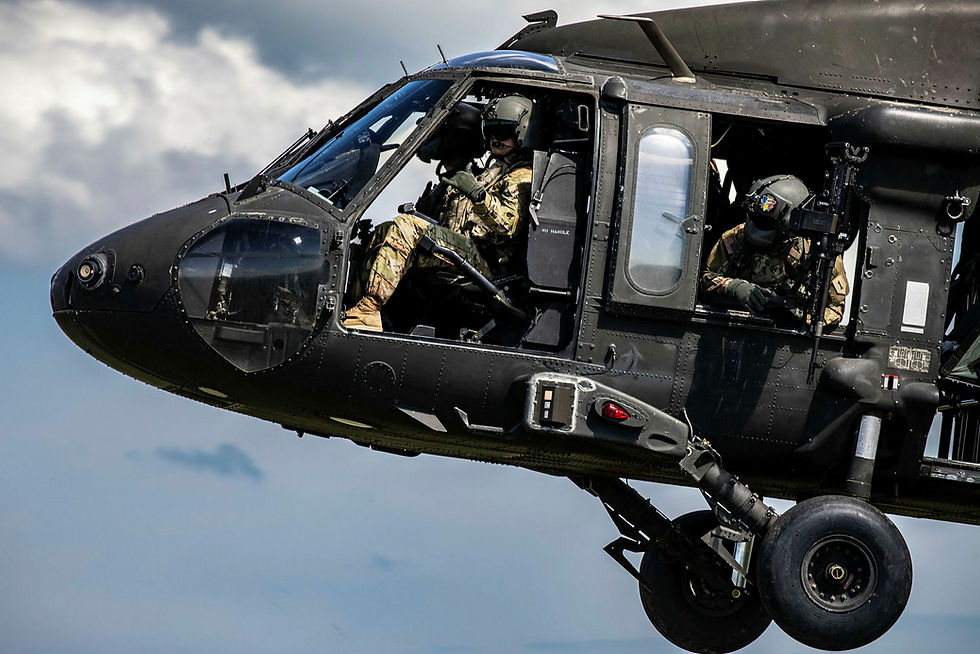
For the past seventy years, the concept of a "VTOL transport aircraft" has been almost exclusively synonymous with one machine: the helicopter.
From the early troop transports of the 1950s to the complex utility and attack platforms of today, the core safety philosophy for occupants has been built around passive crashworthiness. We designed airframes that crumpled progressively, landing gear that absorbed energy, and fuel systems that resisted rupture.
At the heart of this philosophy sits the crashworthy seat. It is a proven, life-saving piece of engineering designed to do one job: protect an occupant during a survivable impact, primarily by "stroking" to manage vertical G-loads in a hard landing or autorotation.
This philosophy has been effective. But a new class of aircraft is emerging that challenges the very definition of "VTOL transport," and it's time to ask if our safety philosophy is dangerously anchored to the past.
The Problem: New Aircraft, New Risks
The V-22 Osprey was the first major exception to the helicopter-only rule. It's now being followed by a wave of new platforms, from the Future Vertical Lift (FVL) programs in the military to a booming civilian tiltrotor and eVTOL (electric VTOL) market. It is also not a giant leap to postulate that VTOL jet transport aircraft will eventually be developed, expanding the performance envelope well beyond what even a tiltrotor can provide (after all, jet VTOL is a well-studied field thanks to the Harrier and F-35).
This shift presents a fundamental problem. These aircraft are not just faster helicopters; they are a unique hybrid class. While they share characteristics with both fixed-wing aircraft and rotorcraft, they also possess unique risks.
A Higher-Energy Envelope: As we chase performance, operational speeds and altitudes will increase. With this comes the potential for far higher-energy collisions or uncontrolled descents, creating impact forces that no crashworthy seat can be designed to handle.
Unique Failure Modes: We must consider that new tiltrotor and jet-lift aircraft have failure conditions that cannot be addressed by existing passive safety technologies. Catastrophic asymmetric lift, flight control failure during the critical transition phase, or total power loss in a hover (without the autorotation capability of a helicopter) are not scenarios that end in a "hard landing." They are, by nature, un-survivable. We have, after all, seen multiple tragic accidents on the V-22 platform that demonstrate these new risks are real.
The "Edge of the Envelope": While civil aircraft may be certified to operate well within known limits, military applications will always chase greater capabilities. These systems will be used closer to the edge of their performance envelopes, where failures are inherently more likely.
Is a crashworthy seat, designed for a low-altitude helicopter impact, truly a sufficient primary safety system for a tiltrotor transport at 20,000 feet, or for occupants in a military FVL platform pushing its limits?

Are We Anchored to an Old Solution?
This leads to the central question: Have we simply defaulted to crashworthy seating because it's what we've always done?
This is a classic case of "design anchoring." The helicopter world adopted this solution out of operational necessity (cost, and especially weight). But by carrying this solution over as the only solution, we may be failing to see the problem clearly.
We must ask ourselves: Have we truly considered the VTOL transport problem space without a solution already in mind?
The very architecture of a traditional helicopter—with its massive main rotor disc—precluded most discussions of active escape systems. But the proposed architectures for new tilting-thrust and VTOL aircraft do not feature these same intractable barriers.
Should we be considering alternative or, more likely, supplementary systems for these aircraft types? Are we anchored to the existing forms of both crashworthy seats and ejection seats, or should we be looking to fundamentally reimagine passenger safety for this new era?
A Call for Discussion

This is not an "either/or" argument. Passive crashworthiness will always be a vital layer of protection for survivable incidents. But we must move beyond a one-track mind. The goal should be a tiered safety system that addresses the full spectrum of risk:
Passive Safety (The Seat): Protects occupants from a survivable impact.
Active Safety (The Recovery System): Saves occupants from an un-survivable incident.
We have a rich history in aerospace of developing novel safety systems to meet challenging new requirements. When faced with the extreme egress challenges of supersonic flight, engineers developed the crew escape capsules used in aircraft like the F-111. More recently, Ballistic Recovery Systems (BRS) have become a standard, life-saving feature on many high-performance civilian aircraft. These technological precedents prove that when the will and the requirement are clear, we can engineer innovative solutions far beyond the conventional.
How do we ensure that the occupants of these next-generation aircraft have safety systems that protect them should the worst happen? The time to start this discussion is now—before these revolutionary aircraft fill our skies, and before we are forced to learn these lessons from an accident report.

Comments